For about $300, you can now buy a headset that reads your brainwaves. Slip it on, think hard about something, and a computer somewhere tries to figure out what you meant. It sounds like science fiction. It partly is. But consumer EEG headsets are real, they’re shipping today, and they’re slowly getting better at a very hard problem: turning your thoughts into clicks. The space is equal parts genuinely fascinating, deeply limited, and filled with marketing that oversells by a wide margin. Let’s sort through what these devices actually do and don’t do, and whether one is worth your time and money.
What EEG Actually Measures
EEG stands for electroencephalography, which is a great word for Scrabble and a terrible one for everyday conversation. All it really means is measuring electrical activity in the brain by putting sensors on the scalp.
Your brain is an enormous tangle of electrical wiring. Something like 86 billion neurons, each firing tiny electrical pulses, constantly. When large groups of neurons fire together in rhythm, they produce measurable voltage changes at the surface of your skull. EEG sensors pick up those changes, the same way a stethoscope picks up a heartbeat. They don’t read thoughts the way a book is read. They read patterns, and the patterns correspond, very roughly, to mental states: focused, relaxed, drowsy, alert, surprised.
Different patterns have names that sound like they came from a superhero comic. Alpha waves (8 to 12 cycles per second) are associated with relaxed wakefulness, often visible when you close your eyes. Beta waves (12 to 30) are associated with active thinking and problem-solving. Theta (4 to 8) with drowsiness, daydreaming, or deep meditation. Delta (under 4) with deep, dreamless sleep. Researchers have been mapping these rhythms for almost a hundred years, since Hans Berger first recorded human EEG in 1924 using an astonishingly primitive setup of silver foil electrodes and a drum chart.
The Consumer Version
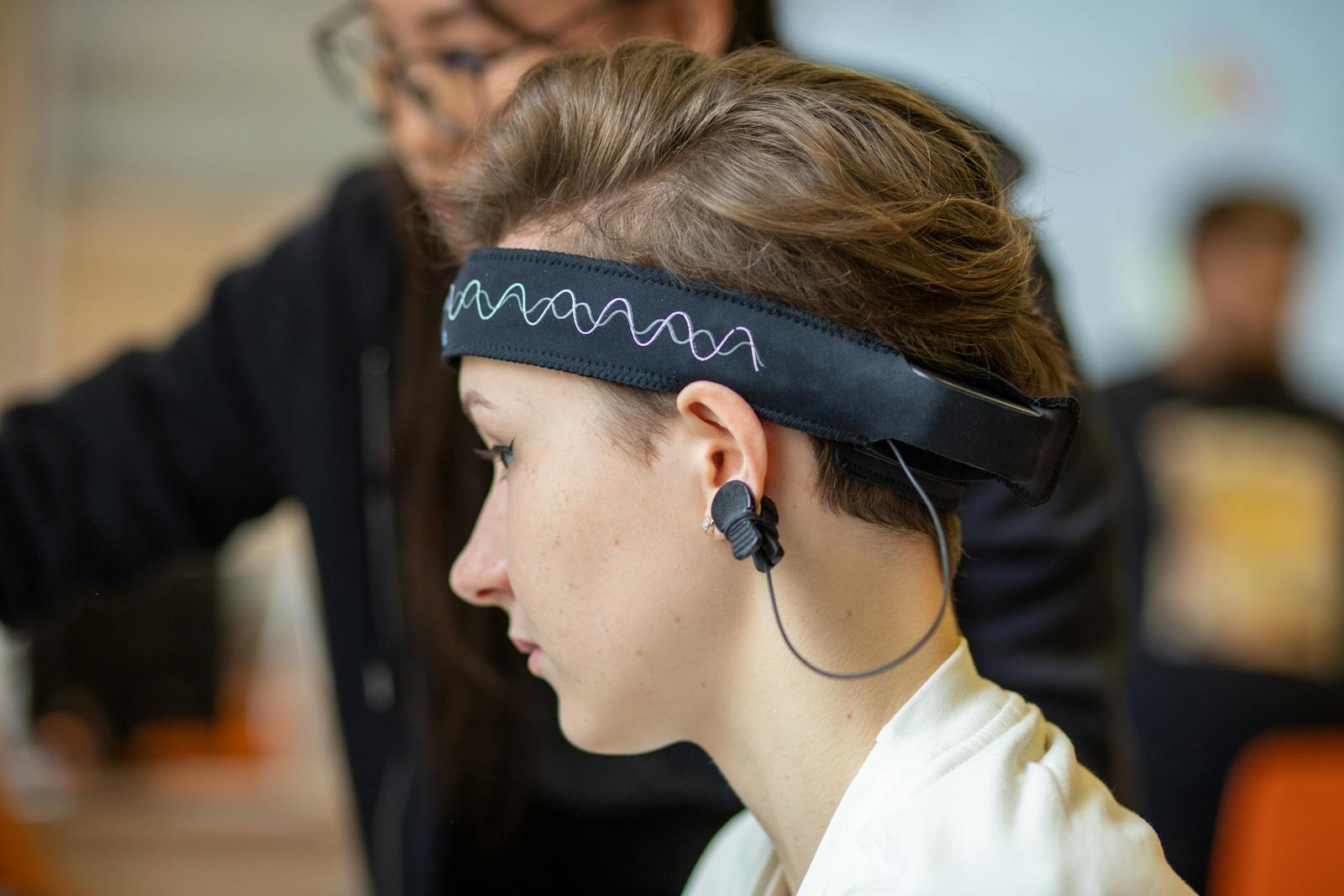
Research-grade EEG uses sixty-four or more electrodes coated in conductive gel, a soundproof room, a specialized amplifier, and a technician who spends twenty minutes fitting the cap. That’s obviously not happening in your living room. Consumer headsets make three big compromises to work at home:
- Fewer electrodes. Most consumer models have two to fourteen sensors, compared to sixty-four or more in a lab. Less coverage means less spatial detail about where in the brain the activity is coming from.
- Dry electrodes. No conductive gel means convenience, but also much noisier signals. A signal a lab would consider unusable is often all the consumer device has to work with.
- Simpler classifiers. Instead of distinguishing hundreds of brain states, consumer devices try to reliably distinguish two or three, like “focused” versus “relaxed.” The fewer categories you try to classify, the more accurate the classification.
The result is a device that can tell when you’re calm versus stressed, focused versus distracted, or awake versus drifting off. It will not, despite what some ads suggest, read the word you’re currently thinking or decode dreams. The gap between what’s physically possible with scalp electrodes and what’s being sold is often enormous, and the marketing departments know it.
What People Actually Do With Them
The most successful applications today are surprisingly un-flashy. Meditation apps use EEG headsets to show you, in real time, when your mind wanders. That feedback loop turns out to be genuinely useful for people learning to focus. Over a few weeks, users can often tell the difference between a calm mind and a busy one without the headset. The device becomes training wheels for an internal skill.
Sleep tracking gets much more accurate when a headband can detect actual sleep stages instead of guessing from wrist movement. Products like the Muse S and Dreem have real users who swear by them for insomnia, because being able to see an accurate hypnogram of last night’s sleep is more actionable than a generic “you slept poorly” notification from a smartwatch. Researchers also use consumer-grade headsets to help people with severe disabilities select letters on a screen by focusing their attention, which is slow but life-changing when it’s your only option for communication.
Gaming with EEG has been promised for over a decade and remains a niche curiosity. The input speeds are too slow and the error rates too high for most serious applications. You’re not going to aim a sniper rifle with your mind; you might, with practice, navigate a simple menu. Workplace focus monitoring is starting to appear, though that use case raises obvious questions about whether your employer should have live access to your attention levels. A few jurisdictions are already debating laws specifically to limit this.
Clinical EEG uses 32 to 256 electrodes with conductive gel and a controlled environment. A consumer headband uses 4 to 16 dry electrodes in your living room. The two devices are not measuring the same thing.
The Different Kinds of Consumer Headsets
Not all consumer EEG devices are the same. The market has split into a few distinct categories. Meditation headbands like the Muse are lightweight, cover only the forehead, and focus entirely on giving feedback during mindfulness sessions. They’re easy to use, inexpensive relative to the category, and genuinely useful if that’s what you want.
Sleep-focused devices like the Dreem are designed to be worn overnight, with soft fabric construction so you can sleep comfortably. They use EEG to accurately identify sleep stages and sometimes play audio cues to encourage better sleep. Gaming and research-oriented headsets like the Emotiv have more electrodes, cover more of the scalp, and give you access to raw signal data. They’re for tinkerers and researchers, not casual users, and they require more setup per session.
Prices range from about $200 for a basic meditation band to over $1,000 for a research-grade consumer device with more electrodes. Before buying, decide what specific problem you’re hoping to solve. A device built for meditation is terrible for sleep tracking, and vice versa. The category with the clearest product-market fit remains meditation feedback, because it’s the use case where EEG’s limitations matter least.
The Real Science, and the Real Limits
It helps to understand why EEG is fundamentally limited. Your skull is an excellent insulator. Electrical signals from deep in your brain have to travel through cerebrospinal fluid, the membranes around the brain, bone, and skin before they reach a sensor on the scalp. By the time they get there, they’ve been smeared out and attenuated. It’s like trying to identify individual conversations in a crowded restaurant by pressing your ear to the outside wall of the building. You can tell there’s a crowd, and roughly how loud it is. You can’t tell who’s ordering the fish.
The only way to read specific thoughts from the brain is to put electrodes inside the brain itself, which is what systems like Neuralink aim to do. That’s a completely different category of device, one that requires brain surgery, and it’s still at an early stage. What’s sold in consumer products today has not crossed that gap and probably won’t in our lifetimes.
If a product promises to "read your mind," "detect emotions," or "translate thoughts," the marketing has outrun the science by at least a decade. Treat that claim the way you would a horoscope with a USB cable.
What to Be Skeptical About
EEG is not a lie detector, a dating assistant, a productivity oracle, or a window into the soul, no matter how the marketing copy is phrased. Any product claiming to read specific thoughts, memories, or emotional content from a two-sensor headband is overpromising by several orders of magnitude. The neuroscience just isn’t there yet, and won’t be for the foreseeable future from surface electrodes alone.
Be especially wary of any app that streams your raw EEG data to a cloud server. Brain signal data is personal in a way few people think about. Patterns in your EEG can reveal conditions you haven’t been diagnosed with, including some neurological and psychiatric conditions, as well as sleep disorders. A few jurisdictions are starting to regulate “neural data” as a special category, and for good reason. Before you buy, check where the data goes and who can access it.
Getting a Clean Signal Is Harder Than It Looks
One thing that surprises new users: getting a usable reading is finicky. Hair gets in the way. Skin oils interfere. Movement creates huge spikes in the signal that swamp the actual brain activity. Every time you furrow your brow or clench your jaw, the muscle activity registers as a massive electrical disturbance that dwarfs any brainwave. A headset that claims “five-minute setup” usually means five minutes to put it on and twenty minutes to sit still enough to get a clean reading.
Dry electrodes help with convenience but make the signal quality problem worse. The electrodes need good contact with the scalp, and they need it consistently across the whole session. Users quickly learn that the same headset can give great readings one day and noisy garbage the next, depending on hair products, humidity, and whether they bumped it while putting it on. For clinical applications this is solved by gel and technicians; for consumer use, it’s managed by averaging over longer windows of time, which means less responsive feedback.
Where the Field Is Going
Consumer EEG is getting better, slowly. Electrode materials are improving. Machine learning models trained on huge datasets are doing a better job of distinguishing real brain activity from noise. Headsets are getting lighter and more comfortable. What’s not changing anytime soon is the fundamental physics of trying to read specific brain states through bone and skin. Expect incremental improvements in meditation apps, sleep tracking, and assistive communication tools. Don’t expect consumer-grade telepathy any time this decade.
The most interesting research frontier is combining EEG with other signals: heart rate, breathing, skin conductance, and eye tracking. These “multimodal” wearables can identify mental states more reliably than EEG alone, because they triangulate from several different physiological channels. This is where consumer devices will probably make their biggest gains over the next few years: not better EEG, but EEG plus more.
My Honest Take
EEG headsets aren’t mind readers. They’re mood readers, attention meters, and very rough input devices. The hype cycle keeps promising telepathy; the actual products keep delivering something narrower and more useful. If you’re interested in meditation feedback or better sleep tracking, they’re worth a look. If you’re hoping to control your computer by thinking, save your money for another decade. That’s usually how breakthroughs go: they arrive quietly, dressed as a meditation app.
Key Takeaways
- EEG measures broad brain states (focused, relaxed, drowsy), not language, not images, not specific intent.
- Two-class control (e.g. left / right) works in lab demos. Useful, free-form input does not.
- Skepticism about marketing claims is the right default, the science of consumer BCI is real, but small.
Start Your Free Trial Today
Full All-Access to hands-on labs, PBQs, and certification tracks, no credit card required.
Start Free Trial