The Certified Privacy Engineering Specialist (CPES) is an advanced, vendor-neutral certification for the engineers and analysts who build privacy into products rather than bolt it on. It validates that you can apply the core principles and lawful bases, threat-model privacy with LINDDUN, minimize and map data, choose the right privacy-enhancing technology from pseudonymization to differential privacy, engineer consent, subject-access and deletion so they actually work across every copy, and run the assessments, breach duties and program that keep it all accountable. The exam is computer adaptive and performance-based, and the credential is kept current through continuing education.
| Level | Advanced. A specialist credential: it goes deep on engineering privacy into systems and assumes working software, data or security experience. |
|---|---|
| Delivery model | Computer adaptive, three stages. Your score on each stage selects the difficulty of the next, so no two candidates sit the same paper. |
| Format | 120 questions. A performance-based exam that includes performance-based questions and multiple-choice questions. No vendor product knowledge required. |
| Time | 180 minutes for the whole exam, timed. Autosaves every answer. |
| Scoring | You need a score of 700 out of 900 to pass. Results are reported on a scale of 100 to 900, and 700 corresponds to answering 72% of the exam correctly. Harder questions carry more weight, so a score means the same thing on any route. Multiple-response items and PBQs are all or nothing. |
| Retakes | No waiting period after a failed first attempt. Every attempt is paid for at the exam price. See the CertLabz Certification Retake Policy. |
| Voucher validity | 12 months from purchase, for one sitting. |
| Certification validity | 3 years. Renew with 75 CEUs per cycle and the $55 annual CE fee, or pass the current exam. Renewal details. |
| Language | English. |
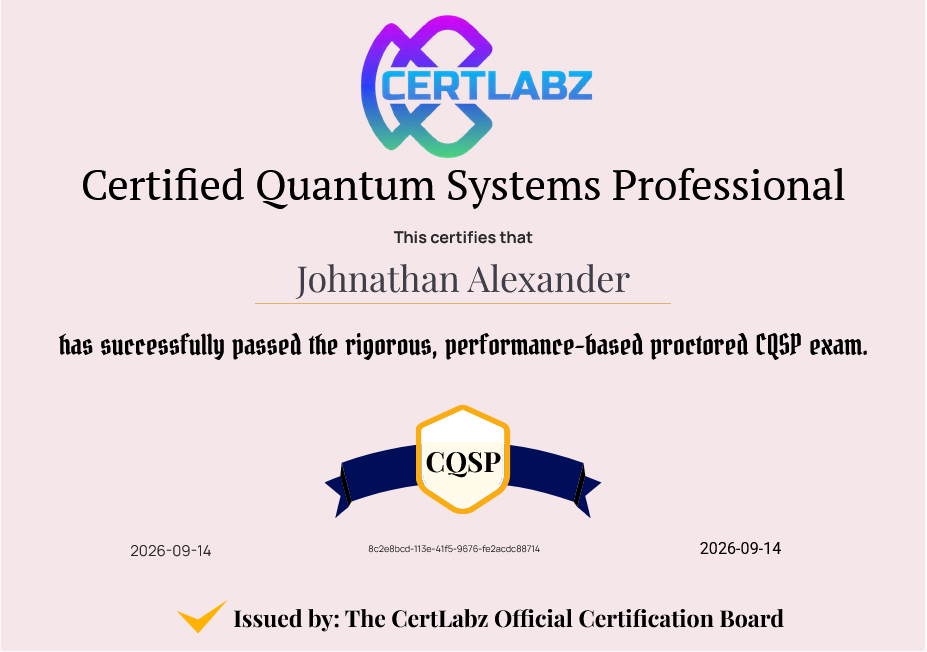
| Credential | PDF certificate with QR code, public verification page, LinkedIn-ready credential ID. Issuer: CertLabz Certification Board. |
| Free resources | The exam objectives PDF and the ten sample questions PDF. |
| Workforce mapping | NICE Framework work roles: Privacy Compliance (OG-WRL-008), Secure Systems Development (DD-WRL-004). O*NET occupations: Information Security Engineers (15-1299.05), Compliance Officers (13-1041.00). Self-declared by CertLabz, not reviewed by NIST or CISA. See the full mapping. |
A signed, verifiable:
The CPES is a performance-based exam: it includes performance-based questions alongside multiple-choice questions. Instead of only picking A, B, C or D, you map principles to design choices, match LINDDUN threats to mitigations, sequence a deletion across systems and processors, and judge whether a dataset is truly anonymized. It is computer adaptive, is proctored and timed, needs no mandatory course, and tests engineering privacy into systems rather than reciting law.
Minimization, purpose and storage limitation, lawful bases and rights, turned into concrete, testable design choices.
LINDDUN, data flow diagrams and privacy design strategies applied to find and fix threats before code ships.
Anonymization versus pseudonymization, k-anonymity, differential privacy, tokenization and secure computation, chosen for the job.
Consent, DSAR and deletion pipelines that reach every copy, plus DPIAs, breach duties and metrics that survive an audit.
Privacy engineering is one of the best-paid and fastest-growing corners of the field, because regulation keeps expanding and few engineers can actually build privacy in. Every route is shown here at once, so nothing is hidden behind a control you have to find.
United States pay reported by Glassdoor, checked September 2026. Pay varies by location, employer and experience. No certification guarantees a salary or a job.
| CertLabz CPES | IAPP CIPT | IAPP CIPM | ISACA Data Privacy | |
|---|---|---|---|---|
| What it is | Certification exam | Certification exam | Certification exam | Certificate/exam |
| Computer adaptive | Yes | No | No | No |
| Hands-on PBQs | Yes | No | No | No |
| Focus | Privacy engineering | Privacy technology concepts | Privacy program management | Privacy governance |
| Vendor neutral | Yes | Yes | Yes | Yes |
| Proctored | Yes | Yes | Yes | Yes |
| Questions | 120 | 90 | 90 | Not published |
| Time | 180 min | 150 min | 150 min | Not published |
| Pass mark | 700 of 900 | Not published | Not published | Not published |
| Course required | No | No | No | No |
| Exam voucher | $199 | About $550 | About $550 | Not published |
Compiled September 2026 from the IAPP certification pages (CIPT, CIPM) and the ISACA data-privacy offering. Product names and trademarks belong to their owners; CertLabz is not affiliated with any of them. Confirm current details with each provider.
Six reasons this credential is worth your time, and worth an employer's attention.
One price for the exam, set by its level. Bundles add the study guide and hands-on practice at a saving.
Secure checkout by Stripe. Prices in USD. Sign in or create a free CertLabz account at checkout.
Every form is drawn from a bank of more than 130 items to these exact weights, whichever adaptive route you take. Filter by the area you want to study.
The exam runs in three stages. Your score on each stage selects the difficulty of the next, so a strong candidate is stretched and a struggling one is measured fairly rather than swamped. No two candidates sit the same paper. Harder questions carry more weight, so a scaled score means the same thing whichever route you took.
Each exam can have up to 5 to 12 performance-based questions, drawn fresh on every attempt, alongside the multiple-choice questions. A PBQ is a task rather than a list: you map principles to design choices, match threats to mitigations, sequence a deletion, or judge an anonymization claim. They are scored all or nothing, so partial guesses do not pass.
Yes. Principles, PETs, consent and governance are described generically using the GDPR, LINDDUN and common practice rather than one vendor's product. What you prove transfers across stacks. Where a question involves a tool, it is described generically.
700 out of 900. Results are reported on a scale of 100 to 900, and 700 corresponds to answering 72% of the exam correctly.
There is no waiting period between a failed first attempt and a second attempt. Buy another voucher and sit the exam again when you are ready, and it will draw a fresh adaptive form from the bank. See the CertLabz Certification Retake Policy.
Yes, after three years. Keep it current by logging 75 CEUs during the cycle and paying the $55 annual CE fee before expiry, or by passing the current exam again.
The exam objectives PDF and the ten sample questions PDF. The CPES Official Study Guide is a $50 ebook, included in two of the bundles. Hands-on practice comes with the All Access plan, included in the Complete bundle.
A laptop or desktop with a webcam and microphone, Chrome, Edge or Firefox, a stable connection, and a quiet private room for three hours. Phones and tablets are not supported.
CPES is a continuing-education certification, like the CE credentials from CompTIA and ISC2. It is valid for three years from the day you pass. To keep it, log 75 continuing-education units during the cycle and pay the $55 annual CE fee before your expiry date. Or pass the current version of the exam again.
CEUs are logged from your CertLabz dashboard with supporting evidence. A certification that lapses can be reinstated only by passing the current exam.
Buy a voucher, study the objectives, sit the exam when you are ready. Your credential is issued the moment you pass.