The Certified Digital Asset Trader (CDAT) is a beginner, vendor-neutral certification for people who want to understand digital asset trading. It validates that you understand how crypto markets work, how exchanges and order types function, how to read technical and fundamental analysis, how to manage risk and a portfolio, and how to stay secure and disciplined. The exam is computer adaptive and performance-based, and the credential is kept current through continuing education. This is educational and is not financial advice.
| Level | Beginner. An entry credential: it establishes solid digital asset trading knowledge and assumes some hands-on cryptocurrency use. This is educational and is not financial advice. |
|---|---|
| Delivery model | Computer adaptive, three stages. Your score on each stage selects the difficulty of the next, so no two candidates sit the same paper. |
| Format | 60 questions. A performance-based exam that includes performance-based questions and multiple-choice questions. Concepts transfer across every exchange and asset. |
| Time | 90 minutes for the whole exam, timed. Autosaves every answer. |
| Scoring | You need a score of 700 out of 900 to pass. Results are reported on a scale of 100 to 900, and 700 corresponds to answering 72% of the exam correctly. Harder questions carry more weight, so a score means the same thing on any route. Multiple-response items and PBQs are all or nothing. |
| Retakes | No waiting period after a failed first attempt. Every attempt is paid for at the exam price. See the CertLabz Certification Retake Policy. |
| Voucher validity | 12 months from purchase, for one sitting. |
| Certification validity | 3 years. Renew with 35 CEUs per cycle and the $25 annual CE fee, or pass the current exam. Renewal details. |
| Language | English. |
| Credential | PDF certificate with QR code, public verification page, LinkedIn-ready credential ID. Issuer: CertLabz Certification Board. |
| Free resources | The exam objectives PDF and the ten sample questions PDF. |
| Workforce mapping | No NICE Framework work role covers this credential. O*NET occupations: Financial and Investment Analysts (13-2051.00). Self-declared by CertLabz, not reviewed by NIST or CISA. See the full mapping. |
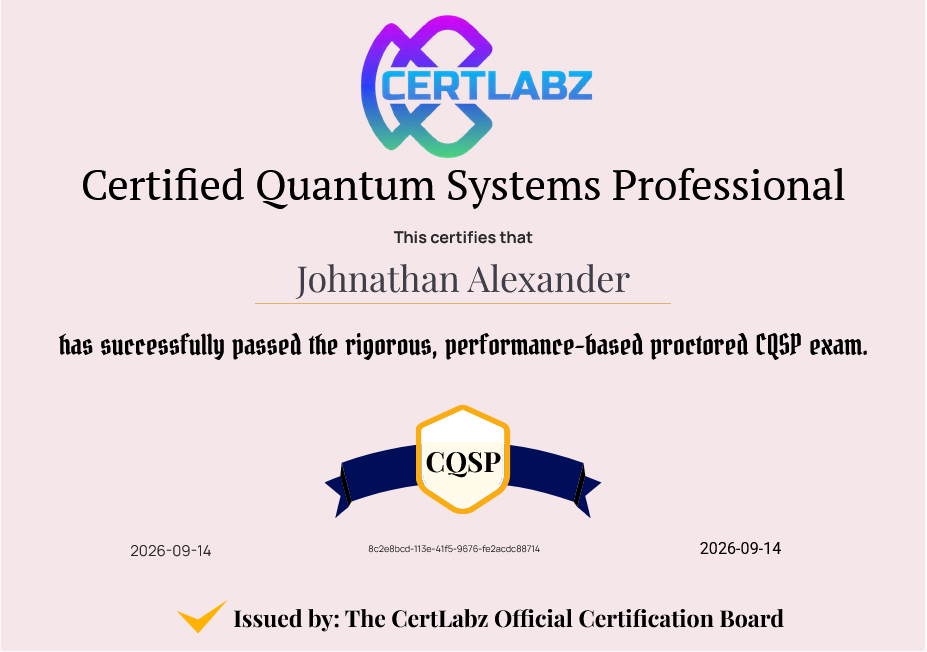
A signed, verifiable:
The CDAT is a performance-based exam: it includes performance-based questions alongside multiple-choice questions. Instead of only picking A, B, C or D, you match tools to their use, order the steps of a trading workflow, read a chart or on-chain signal, and choose the right risk approach. It is computer adaptive, is proctored and timed, needs no mandatory course, and tests trading knowledge rather than reciting one exchange's menus. It is educational and is not financial advice.
How crypto markets work, centralized and decentralized exchanges, order types, order books, fees and slippage.
Charts, indicators, patterns, project fundamentals, tokenomics and on-chain metrics.
Risk management, position sizing, diversification, stop losses, leverage risks and record keeping.
Account and wallet security, scams and avoidance, trading psychology, taxes and responsible trading.
Understanding digital asset trading opens doors across trading, analysis and blockchain roles. Every route is shown here at once, so nothing is hidden behind a control you have to find.
United States pay reported by Glassdoor, checked September 2026. Pay varies by location, employer and experience, and no certification guarantees a salary or trading returns.
| CertLabz CDAT | Blockchain Council Certified Cryptocurrency Trader | |
|---|---|---|
| What it is | Certification exam | Certification exam |
| Computer adaptive | Yes | No |
| Hands-on PBQs | Yes | No |
| Scope | Digital asset trading knowledge, vendor neutral | Cryptocurrency trading |
| Vendor neutral | Yes | Yes |
| Proctored | Yes | Not published |
| Questions | 60 | Not published |
| Time | 90 min | Not published |
| Pass mark | 700 of 900 | Not published |
| Course required | No | No |
| Exam voucher | $99 | Not published |
Compiled September 2026 from Blockchain Council pages; it is a recognized crypto-trading credential (confirm current price with the provider), and the CDAT differs by being computer adaptive and performance-based at $99. Both teach trading knowledge, not financial advice. Product names and trademarks belong to their owners; CertLabz is not affiliated.
Six reasons this credential is worth your time, and worth an employer's attention.
One price for the exam, set by its level. Bundles add the study guide and hands-on practice at a saving.
Secure checkout by Stripe. Prices in USD. Sign in or create a free CertLabz account at checkout.
Every form is drawn from a bank of more than 90 items to these exact weights, whichever adaptive route you take. Filter by the area you want to study.
The exam runs in three stages. Your score on each stage selects the difficulty of the next, so a strong candidate is stretched and a struggling one is measured fairly rather than swamped. No two candidates sit the same paper. Harder questions carry more weight, so a scaled score means the same thing whichever route you took.
Each exam can have up to 5 to 12 performance-based questions, drawn fresh on every attempt, alongside the multiple-choice questions. A PBQ is a task rather than a list: you match tools to their use, order the steps of a trading workflow, read a chart or on-chain signal, or choose the right risk approach. They are scored all or nothing, so partial guesses do not pass.
No. The CDAT is educational. It tests knowledge of how digital asset trading works. It does not tell you what to buy or sell, does not predict prices, and is not financial or investment advice. Do your own research and consult a licensed professional for advice.
The CDAT is vendor neutral and describes exchanges and tools generically, naming products only as examples. It tests the trading knowledge that transfers across exchanges and assets.
Yes. Where a capability such as an order type or an indicator is involved, it is described by what it does, not tied to one product.
700 out of 900. Results are reported on a scale of 100 to 900, and 700 corresponds to answering 72% of the exam correctly.
There is no waiting period between a failed first attempt and a second attempt. Buy another voucher and sit the exam again when you are ready, and it will draw a fresh adaptive form from the bank. See the CertLabz Certification Retake Policy.
Yes, after three years. Keep it current by logging 35 CEUs during the cycle and paying the $25 annual CE fee before expiry, or by passing the current exam again.
A laptop or desktop with a webcam and microphone, Chrome, Edge or Firefox, a stable connection, and a quiet private room for 90 minutes. Phones and tablets are not supported.
CDAT is a continuing-education certification, like the CE credentials from CompTIA and ISC2. It is valid for three years from the day you pass. To keep it, log 35 continuing-education units during the cycle and pay the $25 annual CE fee before your expiry date. Or pass the current version of the exam again. Earning a higher-level CertLabz certification renews it too, the way CompTIA certifications stack.
CEUs are logged from your CertLabz dashboard with supporting evidence. A certification that lapses can be reinstated only by passing the current exam.
Buy a voucher, study the objectives, sit the exam when you are ready. Your credential is issued the moment you pass.