The Certified Information Systems Security Professional (CISSP) remains the gold standard in cybersecurity certification, and in 2024 to 2025 ISC2 refreshed the exam's Common Body of Knowledge (CBK) to keep pace with emerging threats. Zero-trust architecture, AI and machine learning security, supply chain risk management, and cloud-native security have all been elevated in the updated blueprint. If you are planning to sit the exam in 2025, this guide covers every domain, explains what changed, walks you through question types and the Computer Adaptive Testing (CAT) engine, and maps your study plan to the CertLabz CISSP Domain Refresher learning path.

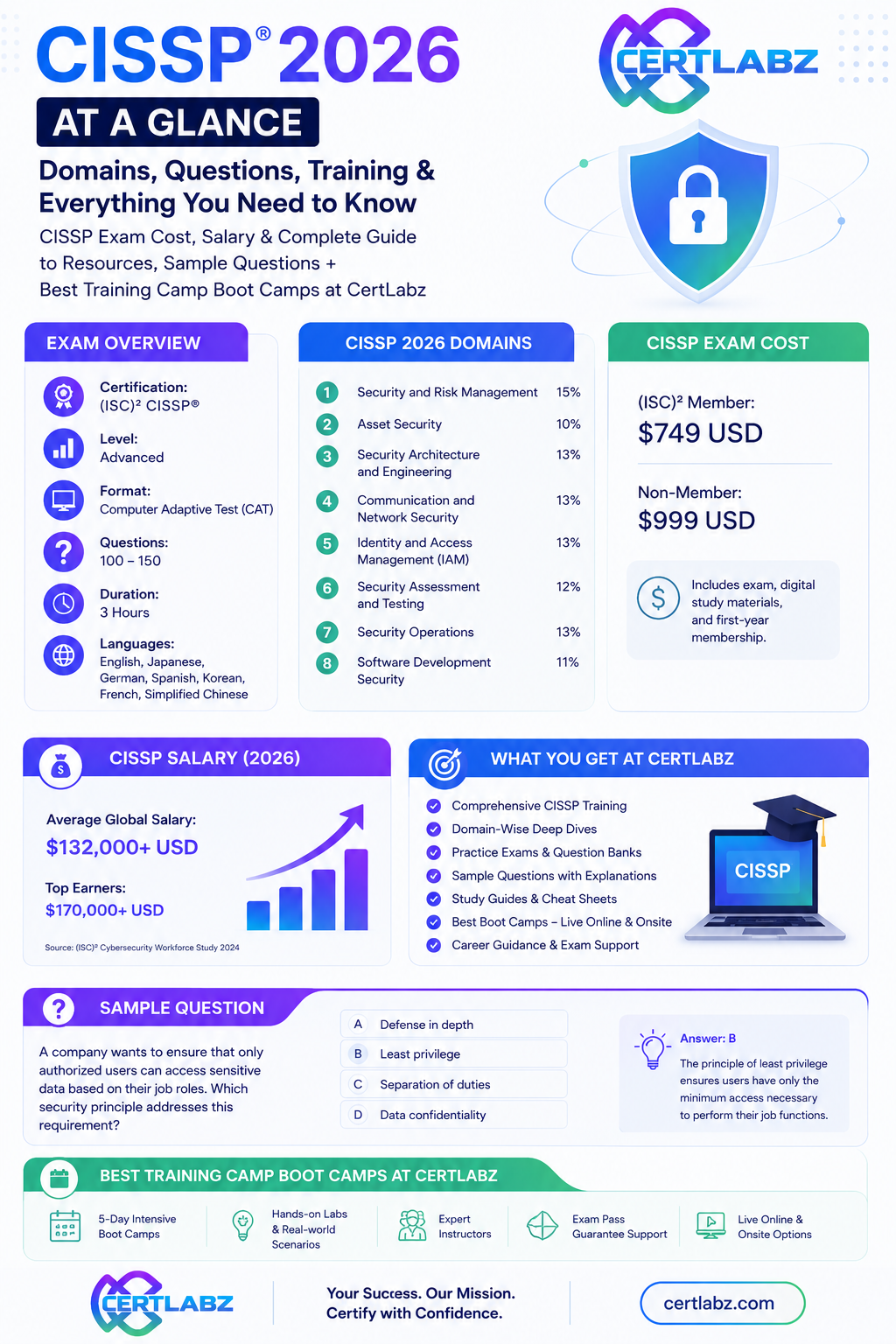
CISSP Exam Quick Facts
✓ Asset Security (10%)
✓ Security Architecture (13%)
✓ Software Dev Security (11%)
The 8 CISSP Domains (2025 CBK)
The CISSP exam is organized around eight knowledge domains, each carrying a specific percentage weight. Questions are drawn proportionally from each domain, so a strong understanding of all eight is non-negotiable. You cannot pass by mastering only two or three.
Domain Weight Distribution
What's New in the 2025 CBK
ISC2 conducts periodic Job Task Analyses (JTAs) to ensure the CISSP exam reflects what working security professionals actually do. The 2024 to 2025 refresh did not restructure the domains, but it did update sub-topic emphasis substantially in several areas.
Domain 3: Security Architecture & Engineering
Zero-trust architecture is now a first-class topic rather than an emerging footnote. Candidates are expected to articulate zero-trust design principles (verify explicitly, use least privilege access, assume breach) and apply them to both on-premises and cloud-hybrid environments. Secure Access Service Edge (SASE), software-defined perimeters, and micro-segmentation all appear in the updated CBK topics. The cryptography section has been updated to reflect post-quantum considerations and the NIST post-quantum cryptography standardization effort.
Domain 8: Software Development Security
AI and machine learning system security has been added as a sub-domain. The updated CBK covers adversarial machine learning threats (data poisoning, model inversion, adversarial examples), secure AI/ML development practices, and the use of AI in defensive security tooling. DevSecOps practices, including shift-left security and automated security gates in CI/CD pipelines, are more prominently tested. Supply chain security for software components, covering SBOM (Software Bill of Materials) requirements, dependency scanning, and third-party risk in open-source components, also received expanded coverage.
Domain 1: Security & Risk Management
Governance, risk, and compliance (GRC) content has been refined to reflect frameworks like NIST CSF 2.0, which was published in early 2024. The updated framework adds a new "Govern" function, and CISSP candidates should understand how it integrates with the existing Identify, Protect, Detect, Respond, and Recover functions. Privacy regulations, including GDPR enforcement trends and the U.S. state privacy law landscape (CCPA, Virginia CDPA, and similar), are tested at the application level rather than at the definitional recall level.
The CAT Exam Format Explained
Unlike traditional fixed-length exams where everyone answers the same 250 questions (the pre-2020 format), CISSP now uses Computer Adaptive Testing. The CAT engine selects each subsequent question based on your performance on previous questions, targeting your individual ability threshold rather than averaging across a static question bank. The CertLabz SkillTracker assessments use the same adaptive philosophy so you train on the format you will see on exam day.
Exam Logistics
- 125–175 questions
- 3-hour time limit
- Pearson VUE test centers
- 700/1000 to pass
- No partial credit
Question Types
- Multiple choice (single answer)
- Multiple choice (multi-select)
- Drag and drop
- Hotspot (click an image)
- Ordered list
Eligibility
- 5 years paid experience
- In 2+ of the 8 domains
- 4-year degree = 1-year waiver
- Endorsement within 9 months
- Pass = Associate if lacking XP
Retake Policy
- 30-day wait after 1st fail
- 90-day wait after 2nd fail
- 180-day wait after 3rd fail
- Max 3 attempts per year
- Full fee each attempt
How CAT Scoring Works
The exam does not stop at 125 just because you have answered 125 questions. It stops when the system achieves a statistically confident assessment of your proficiency level. If you are clearly above or below the 700/1000 passing standard by question 125, the exam ends early. If your estimated score is near the boundary, the system continues asking questions up to the 175-question maximum to gain additional confidence. The practical implication is that finishing at 125 questions does not tell you whether you passed or failed. Both outcomes are equally possible at minimum length.
CISSP Practice Questions (2025 Style)
CISSP Practice Questions
Questions reflect the 2025 CBK emphasis. Think like a manager, not a technician.
An organization adopts NIST CSF 2.0. The new "Govern" function is best described as:
A CISO is designing a zero-trust architecture for a hybrid-cloud enterprise. Which principle is most fundamental to the zero-trust model?
A machine learning model used for fraud detection begins producing significantly more false positives after a software update to the training pipeline. The MOST likely explanation is:
A company wants to allow employees to use a single corporate identity to access third-party SaaS applications without entering separate credentials. The BEST solution is:
During incident response, an analyst discovers that an attacker maintained persistence via a scheduled task that downloads a payload from a public code repository. What is the FIRST action the incident commander should authorize?
Key Concepts: Domain Flashcards
Click each card to reveal the explanation. Use arrows to navigate.
Zero-Trust Architecture
Domain 3: Security Architecture & Engineering
Click to flipA security model that eliminates implicit trust based on network location. Every access request is fully authenticated, authorized, and encrypted regardless of whether the user is inside or outside the corporate network. Core principles: verify explicitly, use least privilege, assume breach.
12-Week CISSP Study Plan
Candidates with 3 to 5 years of security experience typically spend 80 to 120 hours preparing for CISSP. The plan below is structured around the domain weights, so heavier domains get more dedicated time. Adjust based on your current role: a network engineer may need less time on Domain 4 but more on Domain 1.
Weeks 1 to 2: Domain 1, Security & Risk Management
Security governance, risk frameworks (NIST, ISO 27001), legal and compliance requirements, privacy law, BCP foundations. Work through the matching CertLabz CISSP Domain Refresher modules and complete the Domain 1 hands-on labs.
Weeks 3 to 4: Domains 3 & 5, Architecture and IAM
Cryptography fundamentals, security models (Bell-LaPadula, Biba), zero-trust design. Then IAM: authentication protocols, SAML, OAuth 2.0, OIDC, privileged access management, directory services. CertLabz IAM labs let you configure federation flows in a sandbox.
Weeks 5 to 6: Domains 4 & 7, Network and Operations
Network topologies, protocols, firewalls, IDS/IPS, network security architectures. Security operations: SOC processes, incident response, forensics, BCP/DRP. These two domains together account for 26% of the exam.
Weeks 7 to 8: Domains 2, 6 & 8, Asset, Testing and Software
Data classification, retention policies. Security testing: vulnerability assessments, penetration testing, code reviews. Software security: SSDLC, OWASP, DevSecOps, AI/ML security threats.
Weeks 9 to 10: SkillTracker Practice, 1,500+ Questions
Work through the CertLabz CISSP SkillTracker (75 adaptive questions per attempt) and the Cybersecurity Analyst Skill Track question banks. Track performance by domain. Domains below 70% need focused review. Practice explaining why each answer is right rather than memorizing.
Weeks 11 to 12: Weak Areas and Mind-Set Shift
Target domains under 70% from your CertLabz SkillTracker scores. Shift your mind-set from "security engineer" to "security manager" because many CISSP questions favor the managerial or policy answer over the immediate technical fix. Take two full-length mock attempts under timed conditions.
The CertLabz CISSP Training Path
CertLabz brings the entire CISSP preparation journey into one platform: lab modules mapped to the CBK, a SkillTracker that follows the CAT format, and blockchain-verified course certificates that count toward your annual ISC2 CPE requirement. No textbook stack, no scattered video logins.
CISSP Domain Refresher (Course Certificate)
Included with paid plans10 lab modules covering all 8 CBK domains with 30 hands-on labs across zero-trust design, IAM federation, incident response, and AI/ML security. Earn 11.5 to 13 CPE credits and a blockchain-verified course certificate on completion.
CISSP SkillTracker Assessment
Adaptive, 75 questionsAdaptive 75-question SkillTracker follows the live CAT engine and reports a domain-by-domain proficiency score. Detailed explanations are written in the CISSP managerial tone so you train the "think like a manager" reflex.
Cybersecurity Analyst Skill Track
Skill TrackPair the CISSP refresher with the Cybersecurity Analyst Skill Track for additional SOC, threat-hunting, and forensics labs that map directly to Domain 6 and Domain 7. Each track issues a blockchain-verified completion certificate.
Cloud Security Skill Track
Skill TrackHands-on cloud labs covering zero-trust networking, SASE, SBOM workflows, and post-quantum-ready key management. Reinforces Domain 3 and Domain 8 of the updated CBK with practical cloud-native scenarios.
Free Course Certificates
Free tierSample several CertLabz course certificates at no cost to confirm fit before subscribing. Each free certificate is blockchain-verified, shareable on LinkedIn, and contributes CPE credits toward maintaining ISC2, CompTIA, ISACA, or EC-Council credentials.
Free CertLabz Trial
7-day full accessSpin up the full CertLabz environment for 7 days: every lab, every SkillTracker, every certificate. Use the trial to complete the first three CISSP refresher modules and get a real domain-by-domain readiness baseline before you commit.
The "Think Like a Manager" Framework
The single most-cited reason experienced security professionals fail CISSP is answering questions with a technician's mindset rather than a manager's. ISC2 designs questions to test security management judgment, not hands-on technical skill. Understanding this distinction is what separates candidates who pass at 125 questions from those who reach 175.
When you encounter a scenario question, apply this filter before selecting an answer:
- Prefer policy over tools: If an answer says "update the firewall rule" and another says "enforce the security policy that requires firewall reviews," the policy answer is usually correct.
- Prefer risk management over risk elimination: CISSP does not expect perfect security; it expects informed risk decisions. Answers that "accept," "transfer," or "mitigate" risk appropriately often outrank answers that eliminate it entirely.
- Prefer long-term over reactive: "Train employees" beats "block the malicious email" when the question is about reducing phishing risk sustainably.
- Prefer protecting people over protecting data: In scenarios with conflicting priorities, life safety comes first, then business continuity, then data protection.
- Prefer least privilege and separation of duties: These are almost always a correct answer component in IAM and access control scenarios.
Exam Day Strategy
The three hours allotted for 125 to 175 questions works out to roughly 60 to 85 seconds per question, which is more time than most candidates realize they have. Anxiety about the adaptive format causes many test-takers to rush unnecessarily. Use the time deliberately.
For each question read all four options before selecting. Many CISSP distractors are plausible and technically correct in isolation, and the question asks for the best answer given the scenario context. Eliminate obviously wrong options first (anything that eliminates risk entirely, anything purely reactive), then evaluate the remaining two using the manager framework. If you are genuinely uncertain, flag the question and move on. The CAT engine handles unanswered questions differently than incorrect ones, and returning to them with fresh context often reveals the answer.
Take the full CertLabz environment for a spin.
7 days, every lab, every SkillTracker, every certificate. Complete the first three CISSP refresher modules and walk away with a real domain-by-domain readiness baseline.
Start Free Trial